Arabescato Arni: complete guide
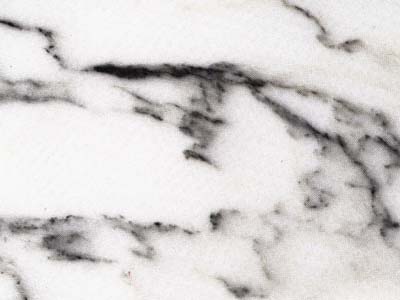
Arabescato Arni is a white Apuan marble crossed by branching grey veins that trace irregular, arabesque-like patterns. It is chosen when you want a classic white but with a bold, recognisable pattern.
History and origin
It takes its name from Arni, a village in the Apuan Alps in the province of Lucca, an area with a long quarrying tradition. In the stonemasons' vocabulary the term arabescato refers to white marbles with dense, interwoven veining, often with a slightly brecciated appearance. It has long been used for cladding, bathrooms and furnishings in high-end interiors. Marmi di Carrara supplies it on request.
Look and veining
The background is white, sometimes with faint pearl-grey hues, crossed by grey veins of varying thickness that interweave to form islands of white. The pattern changes considerably from block to block, so it is best to choose the slabs in person or from photos. Polishing gives the veins contrast and depth; honing softens them and makes the white warmer.
Technical properties (indicative)
| Classification | metamorphic calcitic marble (Apuan Alps) |
|---|---|
| Bulk density | approx. 2,700 kg/m³ (indicative) |
| Mohs hardness | approx. 3 |
| Water absorption | low |
| Main use | interiors: floors, cladding, bathrooms |
| Acid resistance | low: sensitive to lemon, vinegar and limescale removers |
Recommended uses
It is suitable for interior floors and wall cladding, bathrooms, stairs, worktops and washbasins, as well as bespoke furniture. It can be used in the kitchen with awareness, accepting the patina that acids leave over time; outdoors the polish tends to wear off.
Care and maintenance
Clean with neutral detergents and water, avoiding acidic or abrasive products. A stain-repellent impregnating sealer, renewed periodically, limits the absorption of oil and coffee; dulled areas can be restored with professional polishing.
Pairings
- satin brass for taps and handles
- natural wide-plank oak
- walls in warm grey or taupe
FAQ
What is the difference between Arabescato and Calacatta?
Calacatta usually has broader, more isolated veins on a very white background, whereas Arabescato has denser, branching veining, often with a brecciated effect. Arabescato is livelier, Calacatta airier: the choice depends on the pattern you prefer.
Can it be used for a kitchen worktop?
Yes, it is a popular choice, but it is a calcitic marble: lemon, wine and vinegar leave dull marks and the surface scratches more easily than granite. A honed finish makes these marks less visible than a polished one.
Which thickness should I choose?
Floors and cladding generally use 2 cm, worktops and tops 2 or 3 cm depending on the structure and unsupported spans. Thinner tiles are suitable for wall cladding.
How do I order it?
Send us the dimensions, thickness and finish you want: we will prepare a quote on request with photos of the available slabs, so you can choose the pattern before cutting.
Arabescato Arni: available on request
We supply this stone as blocks, slabs, tiles and custom-made pieces. Tell us size, thickness and quantity: we will send photos of the available slabs and a quote within 24 hours.
Similar materials
Marmo Di Estremoz
Marbles · Read the guide →
Rouge Griotte
Marbles · Read the guide →
White Safaga
Marbles · Read the guide →
Milas New York
Marbles · Read the guide →
Danby Montclair
Marbles · Read the guide →
Bianco Arni
Marbles · Read the guide →
Silver Wave
Marbles · Read the guide →