
Perlatto Sicily Marble: Complete Guide
Perlatto Sicily marble is a natural stone prized for its understated elegance and versatility in architecture. Discover its characteristics, recommended uses, and maintenance tips.
History and origin
Perlatto originates from quarries in eastern Sicily, a geological area rich in Mesozoic limestone. Extracted since the 19th century, it has been used mainly in public and residential buildings of southern Italy, where its durability and luminous appearance made it ideal for cladding and flooring. Traditional Sicilian workmanship has preserved the stone's natural beauty, maintaining the typical veins of Mediterranean limestone.
Look and veining
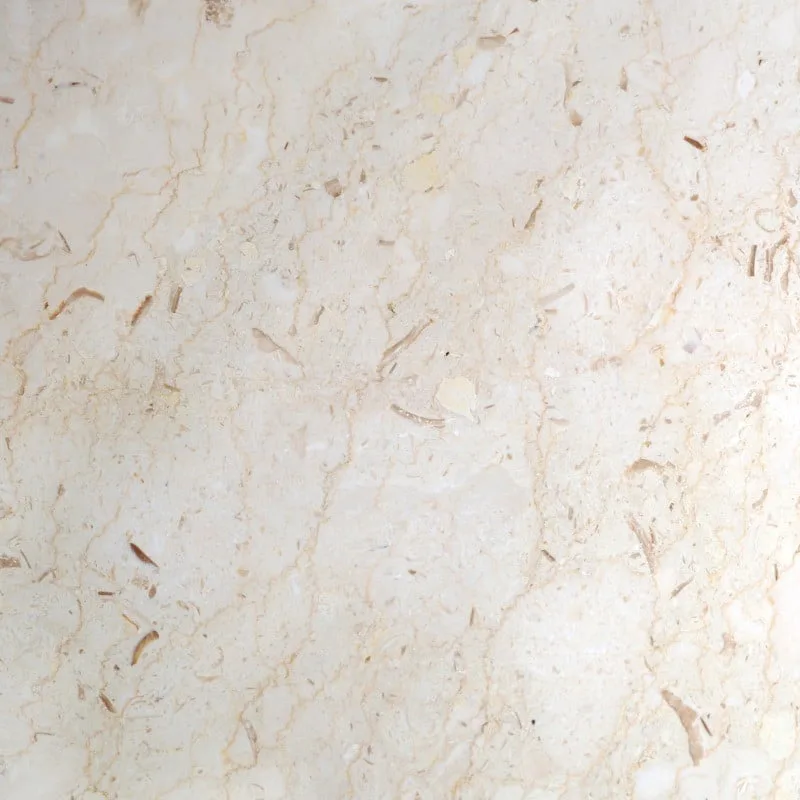
Perlatto features a white or ivory base with subtle gray‑beige shades. The veins are thin, irregular, and darker in tone, creating a delicate yet structured effect. Lighter, almost ivory variants and versions with a slight presence of colored speckles exist, but the main characteristic is its uniform brightness.
Technical properties (indicative)
| Hardness (Mohs) | 3–4 |
|---|---|
| Water absorption | 0.5–0.8 % |
| Freeze resistance | Medium, requires sealing |
| Acid resistance | Low, sensitive to strong acids |
| Density | 2.65 g/cm³ |
Recommended uses
Perlatto is ideal for wall cladding, kitchen countertops, bathrooms, and indoor flooring where light and refinement are desired. It is also suitable for interior stairs and small decorative elements. Its use is not recommended in exterior environments exposed to severe frost or areas subject to frequent contact with aggressive acids, such as chemical laboratories.
Care and maintenance
To preserve its original appearance, clean Perlatto with warm water and neutral detergents. Avoid acidic or abrasive products. Periodic sealing (every 12–24 months) reduces liquid absorption and protects against stains. For superficial stains, act promptly with a soft cloth and a stone‑specific cleaner.
Pairings
- Paired with light wood for a warm‑natural contrast.
- Combined with polished stainless steel for a contemporary, clean look.
- Matched with gray ceramics for a minimalist effect.
FAQ
Is Perlatto suitable for high‑traffic flooring?
Yes, but a slip‑resistant finish and regular sealing are recommended.
Can I use Perlatto in the garden?
It is possible, but it requires a specific protective finish for exteriors and more frequent maintenance.
What is the best daily cleaning method?
Warm water and a soft cloth; for tougher dirt, use a neutral stone cleaner.
Can Perlatto marble be polished to achieve a glossy finish?
Yes, the stone can be polished to various finishes, from matte to glossy, depending on project requirements.
Perlato Sicilia: available on request
We supply this stone as blocks, slabs, tiles and custom-made pieces. Tell us size, thickness and quantity: we will send photos of the available slabs and a quote within 24 hours.
Similar materials

Bursa Beige
Marbles · Read the guide →
Crema Europa
Marbles · Read the guide →
Crema Loja
Marbles · Read the guide →
Crema Cela
Marbles · Read the guide →
Cremo Delicato
Marbles · Read the guide →
Crema Cenia
Marbles · Read the guide →
Dorado Tepexi
Marbles · Read the guide →