Carnelian: the complete guide
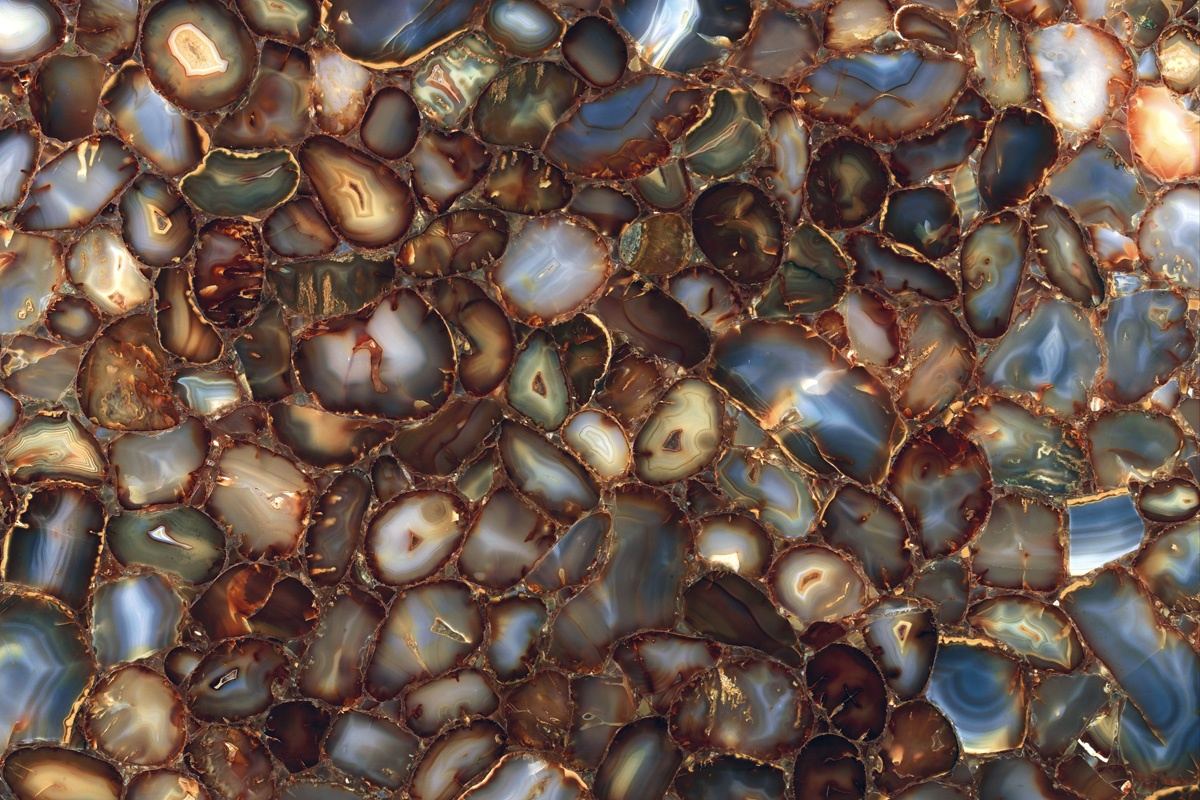
Carnelian in slabs is a composite of orange and red chalcedony fragments bonded with resin. It is chosen for its warm colour and its translucency, which with backlighting turns the surface into a source of amber light.
History and origin
Carnelian is a variety of chalcedony, i.e. microcrystalline quartz, coloured by iron oxides. It has been used since antiquity for seals, engraved gems and ornaments. Today the stones, cut into small pieces, are reassembled into large-format slabs for interior architecture. Marmi di Carrara offers it on request, including in bespoke pieces.
Look and veining
The irregularly shaped fragments range from light orange to brick red, with more transparent and more milky areas. The mosaic texture varies from slab to slab in the density and size of the pieces. Polished, it is brilliant and glassy; with light from behind the tones warm up and the resin joints become more visible.
Technical properties (indicative)
| Classification | semi-precious stone (chalcedony) in a composite slab |
|---|---|
| Bulk density | approx. 2,400-2,600 kg/m³ (indicative) |
| Mohs hardness | 6.5-7 for the fragments, resin softer |
| Water absorption | very low |
| Main use | interiors, decorative and backlit |
| Acid resistance | good for the chalcedony; the resin must be protected from solvents and heat |
Recommended uses
It is at home in luminous walls, bar counter fronts, sculptural washbasins, coffee tables and decorative panels. Avoid floors, sun-exposed exteriors, because UV rays can yellow the resin, and hobs.
Care and maintenance
Lukewarm water and neutral soap with a microfibre cloth are all it needs. Do not use scouring pads, abrasive powders or solvents, which dull the resin.
Pairings
- light woods such as natural oak or ash
- rose gold and copper metals
- sand-coloured plaster and light travertine
FAQ
How does Carnelian look when backlit?
Very striking: the fragments let light through and take on a bright amber tone. An even LED panel, placed at the right distance, is needed to avoid visible hot spots.
How does it differ from an orange onyx?
Onyx is banded calcite, softer and with a continuous pattern; Carnelian is microcrystalline quartz, harder, and has a mosaic-of-fragments appearance.
Can it be used in the kitchen?
Only for decorative elements such as the splashback or the front of an island. On the worktop, heat and utensils would put the resin under strain.
How is Carnelian ordered?
On request: once we have received dimensions and project, we prepare a quote and send photos of the slabs, also against the light.
Corniola: available on request
We supply this stone as blocks, slabs, tiles and custom-made pieces. Tell us size, thickness and quantity: we will send photos of the available slabs and a quote within 24 hours.
Similar materials

Diaspro Rosso
Semi-precious stones · Read the guide →
Rodonite
Semi-precious stones · Read the guide →
Charoite
Semi-precious stones · Read the guide →
Agata Rossa
Semi-precious stones · Read the guide →
Amazzonite
Semi-precious stones · Read the guide →
Legno Pietrificato
Semi-precious stones · Read the guide →
Ametista
Semi-precious stones · Read the guide →